
Three useful recipes
These independent tasks use the same blocks as the complete tutorial. Substitute your own entity names through the selectors.
Create a locked door
Section titled “Create a locked door”- Add a key and door; make the key portable.
- Add Boolean variable door_unlocked = false.
- On the door add verb use, pattern key / literal on / door.
- Set REQUIRES to HAS ITEM key AND CAN REACH key. Use CARRYING instead only if direct inventory is intentional.
- IF door_unlocked, SAY already unlocked. ELSE SET VARIABLE true, OPEN door and SAY success.
- Set the exit’s Traversable when to the flag; keep it visible with clear blocked text.
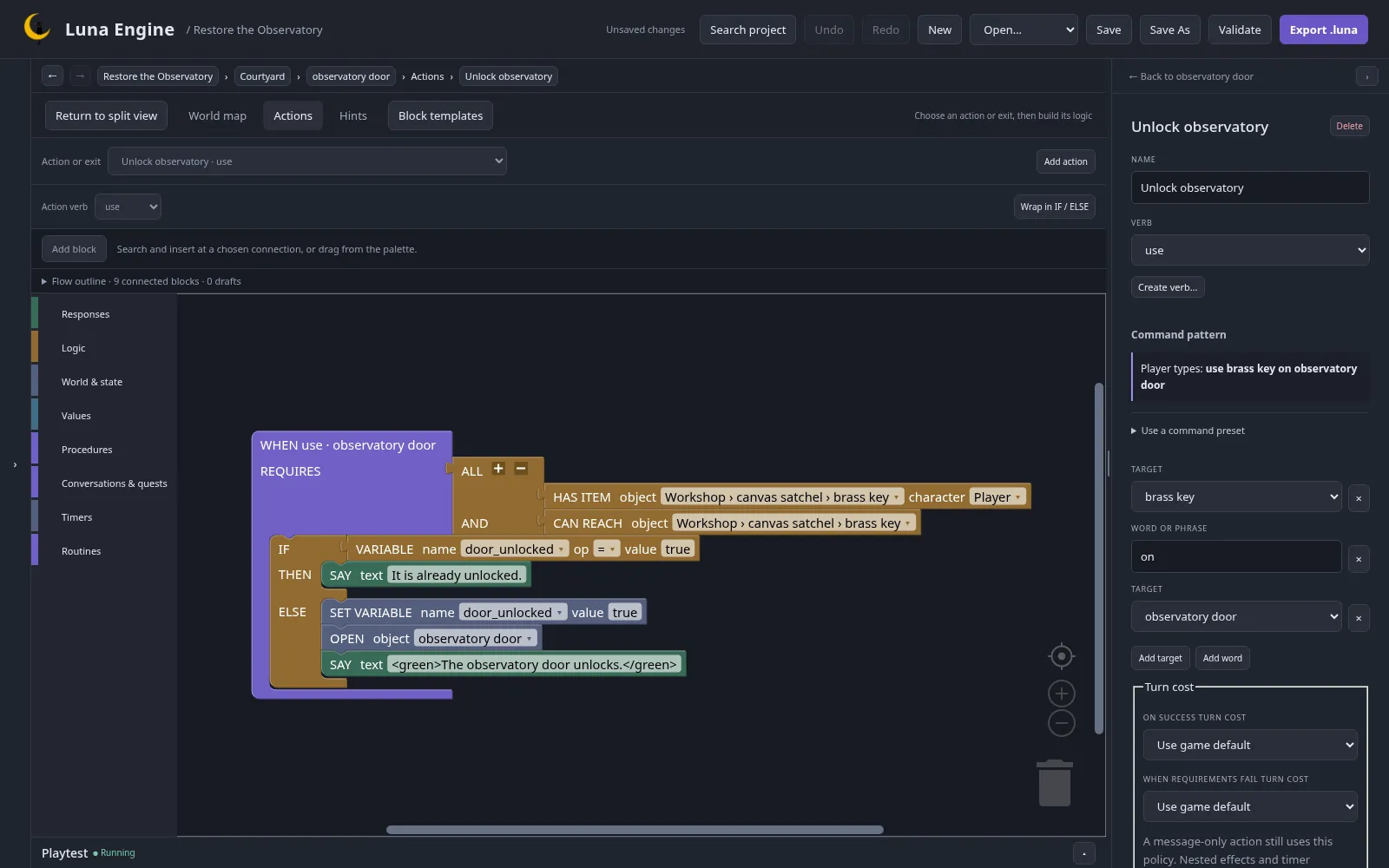
Test no key, closed carried bag, accessible key and a repeat use. Check state as well as text. Full instructions.
Give an item to a character
Section titled “Give an item to a character”- Add a portable item and a nearby character.
- Add verb give with pattern item / literal to / character.
- Require CARRYING item and VISIBLE character.
- Connect GIVE TO CHARACTER, then CHARACTER SAYS a thank-you.
- If this completes a promise, explicitly complete its quest stage and put a reward in On completed.
Try give the book to the keeper. Inspect the character inventory: the book leaves the player’s inventory. Repeating must not grant another reward.
Use a guarded prewritten conversation reply when the handover belongs in a conversation. Calibration example.
End the game when health reaches zero
Section titled “End the game when health reaches zero”- Add integer global health = 3 and a loss ending.
- In Triggers create a value watch on health.
- Mode: When the condition becomes true.
- Condition: health <= 0.
- Connect END GAME to the loss ending.
- In a damage action subtract 1 with UPDATE VARIABLE.
Test 3 → 2 → 1 → 0 and an attack that goes directly below zero. Restore a setup above zero to retest. For an enemy, watch its property and HIDE or MOVE CHARACTER it to an offstage room instead.
The rules chapter includes the complete trigger; values explains why this is a crossing rather than every matching assignment.