
Reusable procedures
Use a procedure when several flows should run the same maintained logic, such as awarding points or handing out a reward.
Build a reward
Section titled “Build a reward”- Open Game data → Procedures, add a procedure and name it
Award points. - Add an Integer input named
amount. - Connect UPDATE VARIABLE for score, adding that local input.
- Connect SAY to report the current score.
- Return to an action and add CALL PROCEDURE.
- Choose Award points and provide
10for amount.
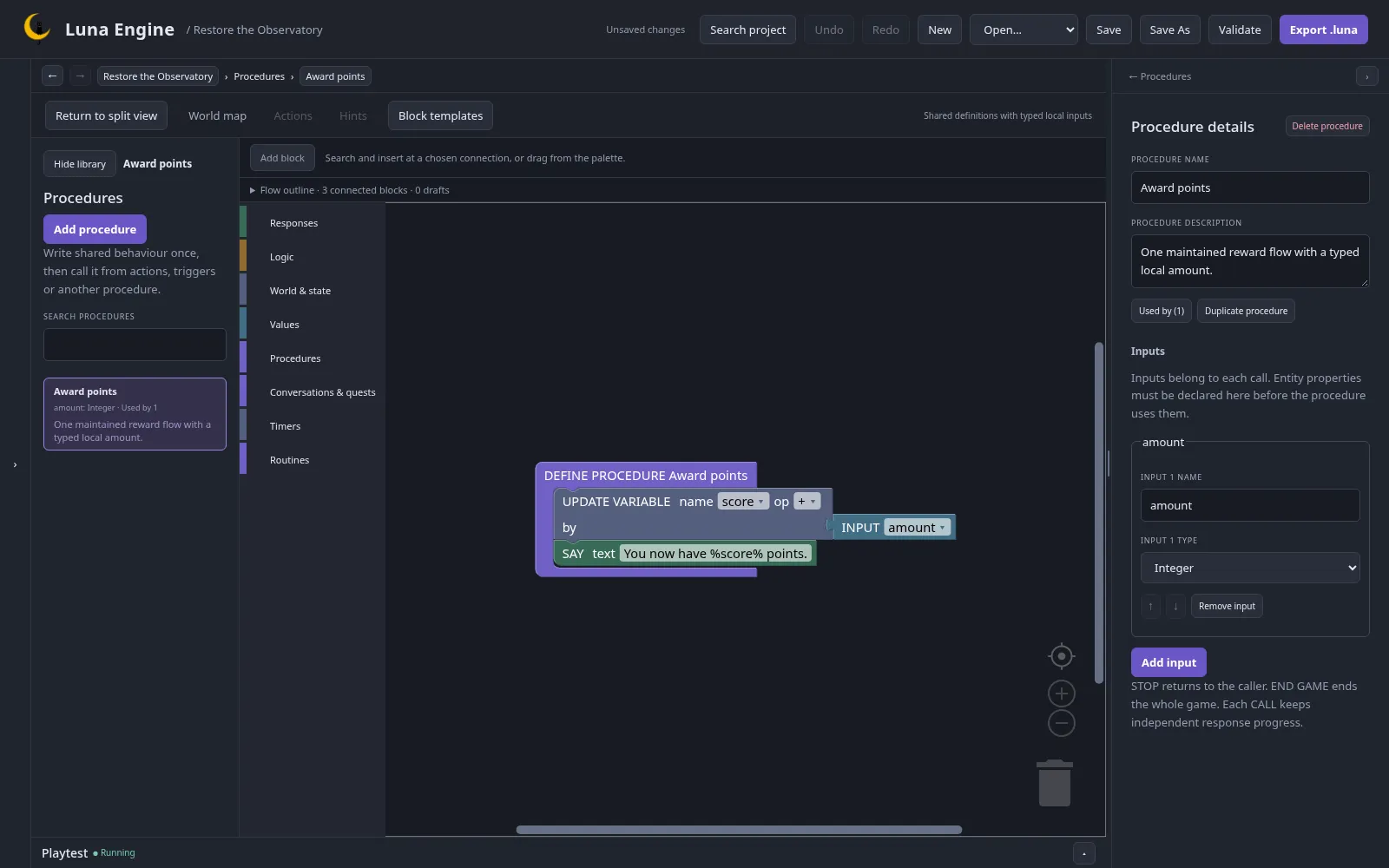
Use Open definition, Return to caller and Used by to move between the definition and its calls. Browse library reopens the procedure list.
Inputs are local
Section titled “Inputs are local”Inputs are typed values or entity references. Entity inputs can require particular properties. CALL arguments must satisfy the signature; changing a shared input opens impact review for existing callers.
A local input exists only during that invocation. It is not a global variable or durable player state. Nested calls bind their own inputs. Message insertion can display input values and entity names in the supported scope.
Progress and stopping
Section titled “Progress and stopping”Response sequences in a procedure keep progress for their invocation path. Two independent call sites do not accidentally share one reply counter. Repeated use of the same path does.
STOP stops the executing flow rather than completing the game. END GAME completes the playthrough. Do not use STOP as a reward-once marker; use state guards or quest hooks.
Inside a procedure, STOP returns from that procedure and the caller continues after CALL PROCEDURE. END GAME exits every caller and completes the game.
Calls, their triggers and later effects share one transaction. If a nested calculation fails, earlier reward mutations and messages from that attempted command roll back.
A template inserts independent copies. A procedure keeps shared behavior synchronized. Start with the simpler choice that matches your intent.